
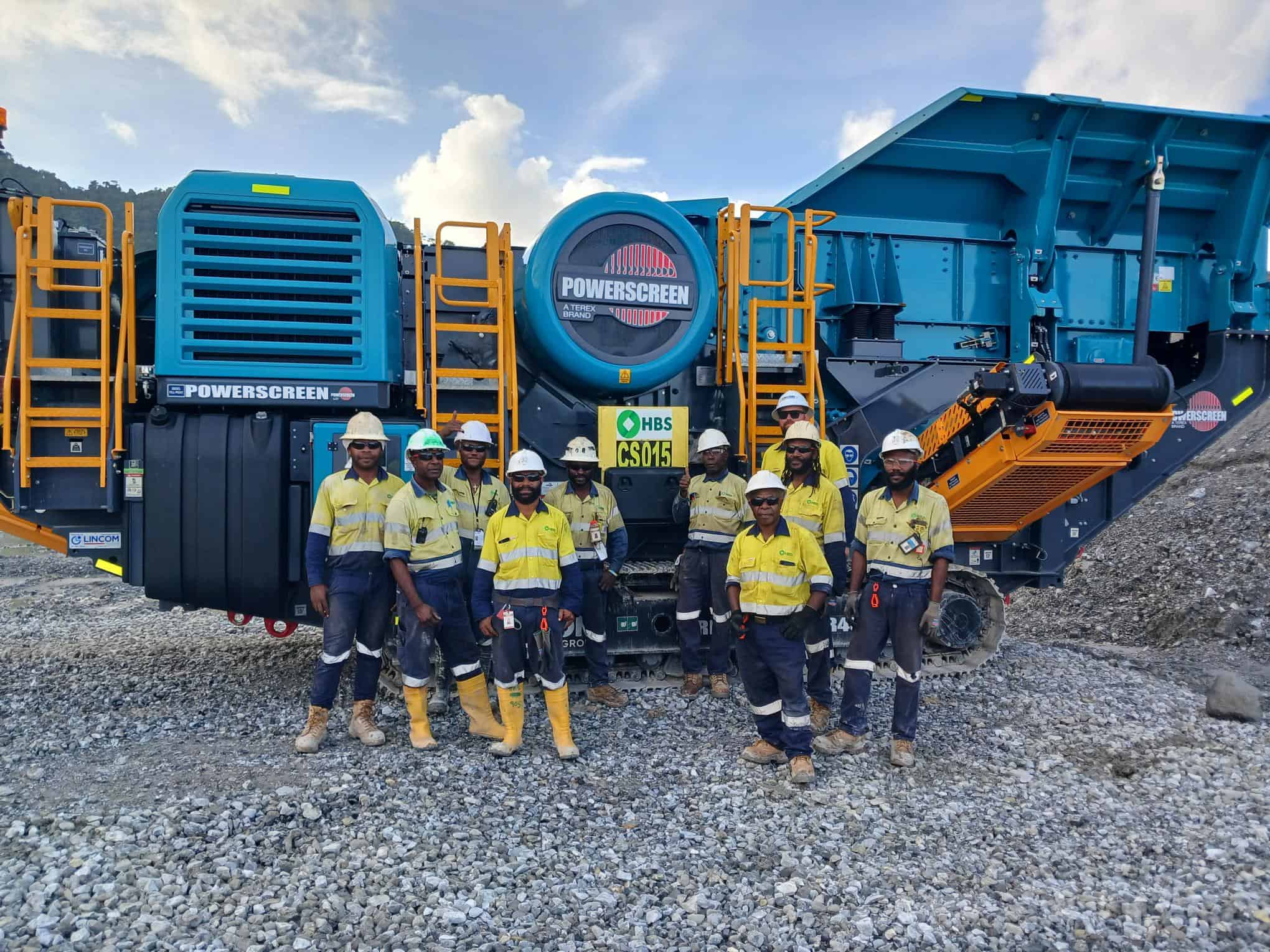
Lincom Group and HBS Machinery have built a partnership in Papua New Guinea defined by reliable equipment, strong after-sales support and ongoing technical collaboration.
For more than a quarter of a century, the relationship between Lincom Group and HBS Machinery has stood as a constant in Papua New Guinea’s (PNG) demanding mining and construction sectors.
Built on trust, technical understanding and consistent after-sales support, the partnership continues to evolve, even as HBS enters a new phase under the ownership of Petrosea – a multi-disciplinary company with a track record of more than five decades in providing integrated services through its mining services, engineering, procurement, construction and installation and logistics support business lines.
The Lincom–HBS relationship has always extended beyond the supply of equipment. From the earliest engagements, Lincom worked closely with HBS to understand the realities of operating in PNG, where logistics, terrain and infrastructure present unique challenges.
This relationship can be traced back more five decades – before the formation of HBS Machinery – with key stakeholders working with Lincom founder Roy Watterson, who has been working on the delivery of machinery in Australia as far back as the 1970s.
“Roy always developed a team that concentrated on not only selling machinery but fully understanding what the customer expected out of the machinery,” the HBS senior stakeholder said. “You have got to understand exactly what you are going to put into it before you can work out what you need for the process.”
A partnership proven in the field
This philosophy was put to the test in 2007, when HBS formed a joint venture for the Hidden Valley project in Morobe Province. Tasked with supplying a complete crusher circuit under tight deadlines, the company faced intense scrutiny from stakeholders concerned about delivery risk.
Through Lincom’s direct involvement, a powerscreen-based solution was selected that could produce road base, sealing aggregates, concrete materials and gabion stone, all within a 90-day window from order to production.
The challenges of the project extended beyond equipment specification, with machinery needing to be shipped internationally, transported across difficult terrain and installed on-site with minimal existing infrastructure.
“At the time, infrastructure around the area wasn’t as sophisticated as it is now,” the stakeholder said. “So getting the equipment to site was about understanding the complex logistics of how to get a 40-something-tonne crusher on a boat, onto a truck, onto site. Roy and the Lincom team dealt with it all.”
With Lincom’s technical input and on-the-ground support, the project met delivery and production targets. The durability of the equipment further reinforced the success of partnership, with key components exceeding 30,000 production hours before replacement.
Over time, the fleet at Hidden Valley has been expanded with additional equipment from Lincom, including supplied circuits for road construction, airport developments and mining operations.
That track record continued in 2016 when HBS secured work at the Lihir mine, a contract it maintains today. Lincom’s role has remained consistent, providing equipment and ongoing support to ensure operational continuity.
Upgrades to the crushing circuit recently got underway, with further changeouts scheduled through to 2026.
The most recent chapter in the partnership reflects continuity and renewal. In the past year, Lincom delivered a new suite of equipment to HBS, including a Powerscreen 1700X three-deck screen, a Maxtrak 1300 cone crusher and a PT450 jaw crusher. Alongside the machinery, Lincom personnel travelled to PNG to provide on-site training for operators, reinforcing the company’s long-standing commitment to workforce development.
Early projects supported by Lincom in PNG saw operations run almost entirely by Papua New Guinean workers, supported by targeted skills development programs to upskill operators. The HBS stakeholder emphasised the importance of this type of approach.
“There is a lot of staff development and training involved,” they said, highlighting how capability-building underpins sustainable operations in remote environments.
That emphasis on training and capability development is closely linked to the broader need for reliable, long-term operational support in remote environments.
For HBS, the value of the partnership with Lincom lies in reliability as much as performance. In a market where access to parts and expertise can be limited, dependable after sales-support is essential.
“You would not consider taking on a project unless you knew you had support,” the stakeholder said. “You do not take any process to PNG unless you have got good back-up and support, which is what we have with Lincom.”
Lincom’s ongoing engagement in the region, including regular site visits and participation in industry forums, has helped maintain that support. The company’s approach demonstrates a clear understanding that long-term success in PNG depends not only on equipment quality, but on partnership, presence and practical expertise.
Lincom’s relationship with HBS is a key example of how value can be delivered through technical collaboration, reliable machinery and a shared commitment to supporting operations on the ground.
This feature appeared in the June/July issue of the PNG Mining.