
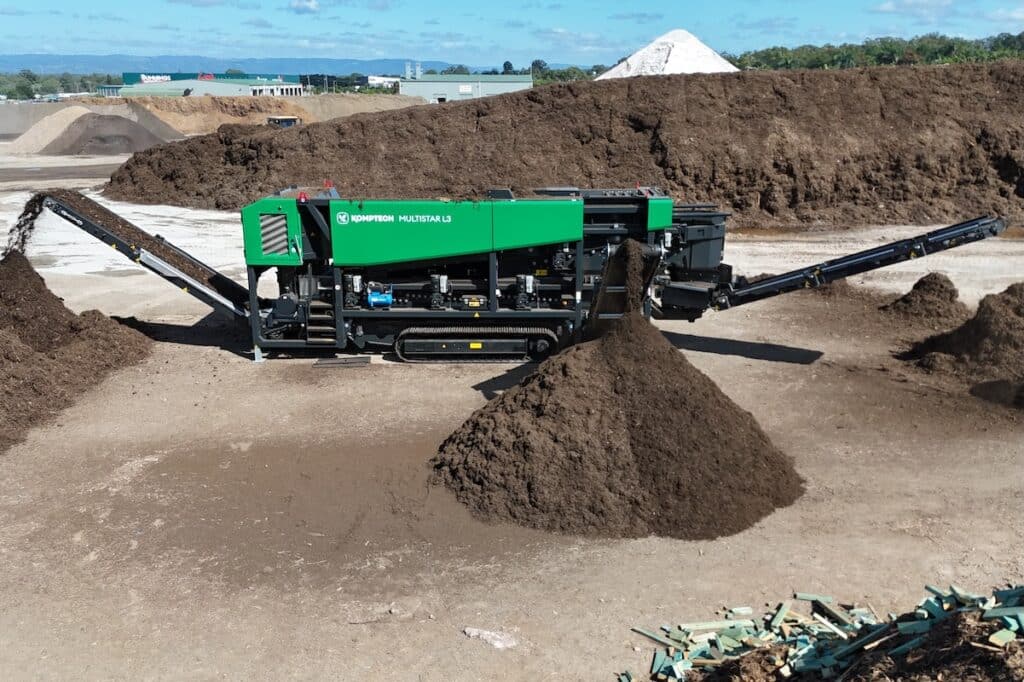
On many sites, fuel is one of those costs that quietly adds up in the background. It’s easy to focus on throughput, tonnes per hour, or machine size. However, over time, it’s the daily burn rate that often has the biggest impact on the bottom line. That’s where Komptech’s Multistar L3 screener changes the conversation.
Rather than relying solely on traditional diesel-hydraulic systems, the L3 is designed around electric drive technology, giving operators a practical way to reduce fuel use without sacrificing performance. When connected to grid power, the machine can reduce energy consumption by up to 75 per cent compared to diesel-driven alternatives. It’s a bold figure, but more importantly, it’s one that’s easy to understand in real-world terms: less diesel, lower emissions, and significantly reduced operating costs.
On a busy composting or recycling site, inefficiencies rarely come from a single source. They build up through rehandling, re-screening, and machines running longer than needed. Material that isn’t properly separated the first time often ends up back in the system, costing both time and fuel. The Multistar L3 is designed to minimise that cycle by doing the job right in one pass, keeping material moving and reducing unnecessary machine hours.
That becomes more important when dealing with wet or variable materials. Anyone who has worked with compost, biomass, or green waste knows how quickly performance can drop when conditions aren’t ideal. Screens can clog, separation becomes inconsistent, and suddenly production slows while fuel consumption climbs. The L3 is built to handle these conditions with consistent separation performance, helping operators avoid the hidden costs that come with poor screening.
Over time, those small efficiencies start to compound. Fewer passes. Less machine time. Lower fuel consumption per tonne. It’s not just about saving energy at the engine, but also about using less energy across the entire operation.
There are also the practical details that tend to matter more the longer a machine is on site. Features like improved wear protection, better maintenance access, and an efficient discharge system don’t always make headlines, but they directly influence uptime and service costs. Less downtime means fewer interruptions, and easier maintenance means machines get back to work faster. Combined with strong after-sales support and access to parts when needed, these factors play a key role in keeping total operating costs under control.
What also stands out is how the L3 balances efficiency with output. With throughput of up to 250 m³/h, it delivers the capacity needed for high-volume operations without relying on oversized engines or excessive fuel use. It reinforces a simple idea: the most efficient machine isn’t the one that burns the least fuel per hour, it’s the one that produces the most usable material for the least energy overall.
While other star screens and trommels promote productivity or lower fuel consumption, few offer such a direct comparison when it comes to energy savings, particularly with the option of running on grid power. And that’s really where the L3 finds its place. For sites with access to electricity, it offers a straightforward way to step away from diesel dependency without compromising on throughput or performance.
For operations dealing with challenging materials, it provides consistency where it matters most. And for businesses focused on long-term cost control, it delivers savings that extend beyond the fuel tank.
At its core, the Komptech Multistar L3 is designed to maximise output while minimising the energy and cost behind it. It’s a shift in how operators think about performance, not just in tonnes per hour, but in energy per tonne.
This feature appeared in the June issue of the Inside Waste website.