
Queensland has some of the most progressive regulations in Australia when it comes to composting and contamination control. Facilities processing more than 200 tonnes of organic material a year must hold an Environmental Authority and manage contaminants under the state’s Environmentally Relevant Activity (ERA 53) guidelines. These rules, strengthened in 2024, put a strong focus on odour management, PFAS limits, and the removal of physical impurities such as plastics, metals, and stones – all key to achieving high-quality compost in line with the Australian Standard AS 4454-2012.
Against this regulatory backdrop, we took part in a three-day trial at a major composting site in Swanbank, QLD, to demonstrate how the Komptech Hurrikan S Separator performs under real operating conditions. The goal was to showcase how this advanced wind sifting could help operators meet compliance standards while improving productivity and compost purity.
Swanbank is a growing industrial precinct known for its contribution to resource recovery and renewable energy. The facility processes large volumes of mixed organic material daily, and like many composting sites across Australia, it faces the ongoing challenge of contamination, particularly from light plastics that are notoriously difficult to separate from organic matter.
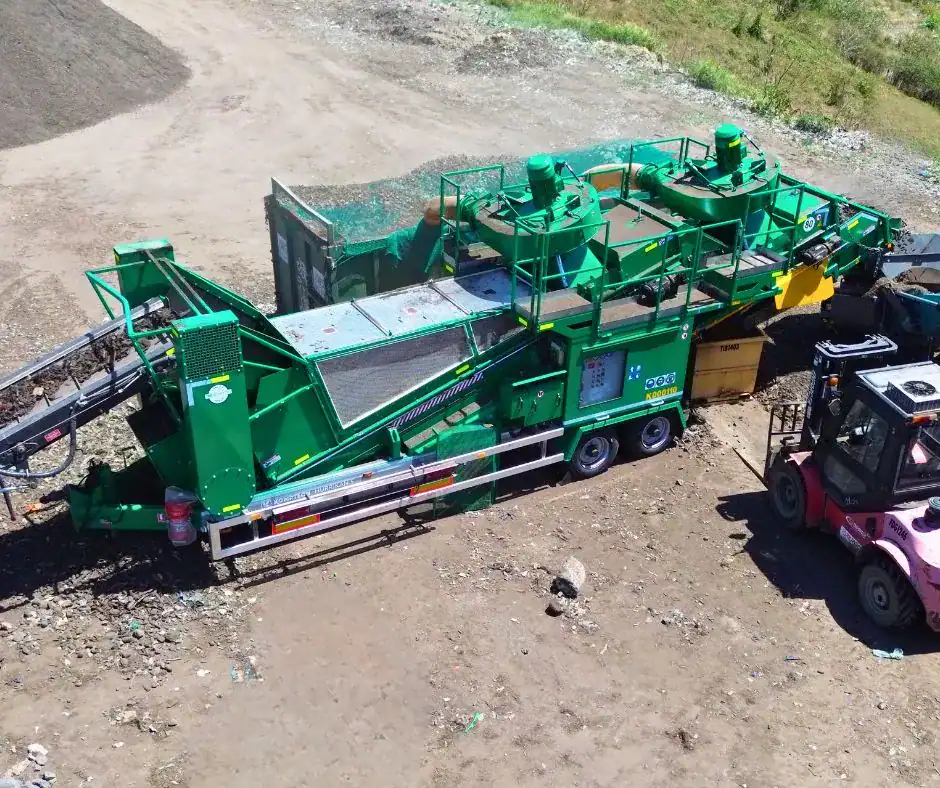
We set up the Hurrikan S alongside a mobile trommel screener, wheel loader, and track stackers to form an integrated system. After the trommel separated the overs, the mix of compost, film plastics, and lightweight packaging was fed into the Hurrikan S. Inside, a patented air-knife system created a strong airflow that lifted and peeled away the light contaminants from the heavier organic material. A suction-blower then captured and removed these plastics from the stream, leaving cleaner compost behind. To keep everything moving smoothly, a vibrating feed conveyor maintained steady flow and prevented blockages. Finally, a rolling fraction separator and magnetic end-roller automatically cleared out stones, rocks, and metals – delivering a clean, refined output with minimal manual handling.
Designed for flexibility and performance, the Hurrikan S is powered by a 55/74 kW drive system. Its dual-fan airflow setup with variable frequency drives, combined with the option for electric or diesel operation, gives operators the choice between mobility and energy efficiency, ideal for large-scale composting environments.
Over the course of the trial, the results spoke for themselves. The machine’s precision airflow technology, rolling fraction separator, and magnetic end roller worked together to remove more than 90% of light plastics, while efficiently separating stones and metals from the compost stream. Throughput reached up to 600 cubic metres per day, with the Hurrikan S consuming just 6 litres of diesel per hour, an impressive figure considering its performance. It can also be connected to mains power for even lower operating costs. By the end of the trial, the skip bin lined with shade cloth was full of recovered plastic, clear evidence of how well the system performed.
The results were immediate: cleaner compost, faster processing, and significantly less manual handling. The trial proved what we’ve long known about the Komptech Hurrikan S – it’s not just efficient; it’s built for the future of composting. As regulations tighten and the demand for high-quality, low-contamination compost grows, we’re proud to help Australian operators stay ahead with equipment that’s both environmentally responsible and operationally effective.