
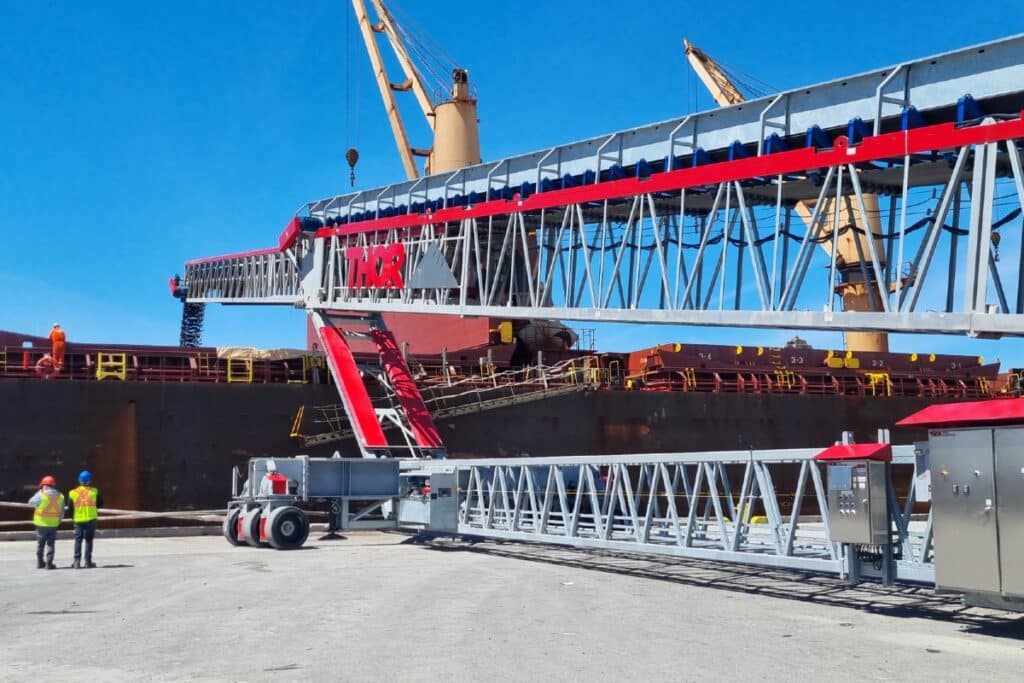
East Arm Resources, a Tasmanian based quarry supplying high quality crushed rocks, specialty products and aggregates to northern Tasmania, is preparing to support future offshore wind developments by supplying and loading large armour rock onto specialist vessels.
The task requires highly specialised equipment, and a traditional shiploading conveyor couldn’t meet the requirements.
Lincom Group and Thor Global provided a solution, of a custom-built ThorStacker T170x54 ship loader, paired with a purpose-built vibratory pan feeder. Both featuring on board power and heavy-duty track-mounted drive units for mobility.
Lincom Group product manager Alan Dunbar said, “the machines had to be strong, fast, and mobile, because of limited available space at the Bell Bay port area.”
“Our customer required a complete mobile solution that can also manage the speed and flexibility of a traditional mobile shiploader,” Dunbar said.
“Both the ship loader and the feeder must be able to move independently of each other.”
Unlike traditional large-scale feeder systems that often rely on fixed ramps or permanent infrastructure, the Thor solution was designed to load directly from ground level without the need for additional civil works.
“The ThorStacker can be loaded by a wheeled loader from the ground without ramps,” Dunbar said.
That mobility requirement also pushed Thor into new engineering territory.
To handle the significant weight of the equipment, the company developed a new oversized track system based on the Thor TRAX design capable of supporting the machines while maintaining manoeuvrability around the site.
The entire system is remotely operated, allowing operators to control the equipment safely from the ground or directly from the vessel itself.
Handling armour rock of this scale also presents major durability and safety challenges for bulk handling systems.
With rocks in the 300mm-375mm size range dropping onto conveyor infrastructure, impact protection became a critical design consideration.
“That is very destructive,” Dunbar said. “We have special custom-built impact beds inside the machines to keep them alive.”
Thor also incorporated specialised scrapers, reinforced structures and extensive side protection systems to minimise the risk of falling material.
“We had to include spillboards down the sides to protect operators and plant, in the event something did come of the side it is contained,” Dunbar said.
The custom-built vibratory pan feeder acts as the first impact point when material is transferred from excavator buckets into the system. According to Dunbar, ensuring that component could withstand continuous heavy impact loading was essential to the project’s long-term reliability.
The Bell Bay project also builds on Thor’s international experience designing bulk handling systems for similar applications overseas.
Dunbar said the company has previously worked alongside stevedore customers globally to develop one of the world’s first dedicated armour rock stackers after competing systems failed under operational conditions.
Thor’s response involved a collaborative trial process where the equipment was supplied and intentionally overloaded and pushed to failure to identify weaknesses and improve the design to make sure it was ready for live service.
“The intention was to live trail the machine, a torture test to locate potential failure points the FEA [finite element analysis] missed or could not foresee in real operation,” Dunbar said.
The lessons learned from those trials directly influenced the latest Bell Bay system, which Dunbar described as the strongest and most advanced armour rock stacker Thor has produced to date.
“The Bell Bay version is kind of the newest generation,” he said.
“It’s the strongest of all the three units suppled this year and it also has its custom-built feeder as well.”
Importantly, the Bell Bay system is also fully self-propelled, a feature that distinguishes it from earlier stationary or towable systems delivered internationally.
The specialist vessels used to place armour rock offshore are expensive, highly specialised assets that require consistent material loading rates to operate efficiently.
Without dependable loading systems in place, project costs can escalate rapidly.
“If you’re not loading, if the boat’s just sitting there empty waiting for equipment availability, it’s just going to cost you a fortune,” Dunbar said.
“It’s what Thor banks their business on. When you buy a Thor product, you improve reliability and uptime.”
Reliability was also a major factor in East Arm Resources’ decision-making process, alongside Lincom Group’s local Tasmanian support capabilities.
The company recently expanded its presence in Tasmania with a new workshop and service facility, allowing it to provide spare parts and technical support closer to the Bell Bay operation.
“In remote places like Bell Bay, you can’t just grab a new part if something goes wrong,” Dunbar said.
“With the new workshop in Launceston, our spare parts and service are never too far, offering quick turnaround to our local customers.”
The equipment was shipped from Canada in 13 containers Lincom Group will oversee the full on-site assembly and commissioning process at the port itself.
With operations expected to begin later this year, the project highlights the increasingly important relationship between bulk handling infrastructure and Australia’s renewable energy transition.
As offshore wind developments continue to expand, specialised material handling systems like the ThorStacker T170x54 are likely to become an increasingly common feature across Australian ports and marine construction sites.
This feature appeared in the July issue of the Australian Bulk Handling Review website.